Open 24 Hours, Every Day (954) 203-8426  |  Book in the TopTec app

Category: AC Tips

  • Hurricane Season and Your AC: How to Protect It Before and After a Storm

    Hurricane Season and Your AC: How to Protect It Before and After a Storm

    Home / Blog / Storm Prep
    Storm Prep

    Hurricane Season and Your AC: How to Protect It Before and After a Storm

    Turn off the breaker before the storm, skip the plastic tarp, and wait 30 minutes after power returns. Complete hurricane AC protection guide.
    By Cooling On Demand Inc.FL License #CAC18228483 min read
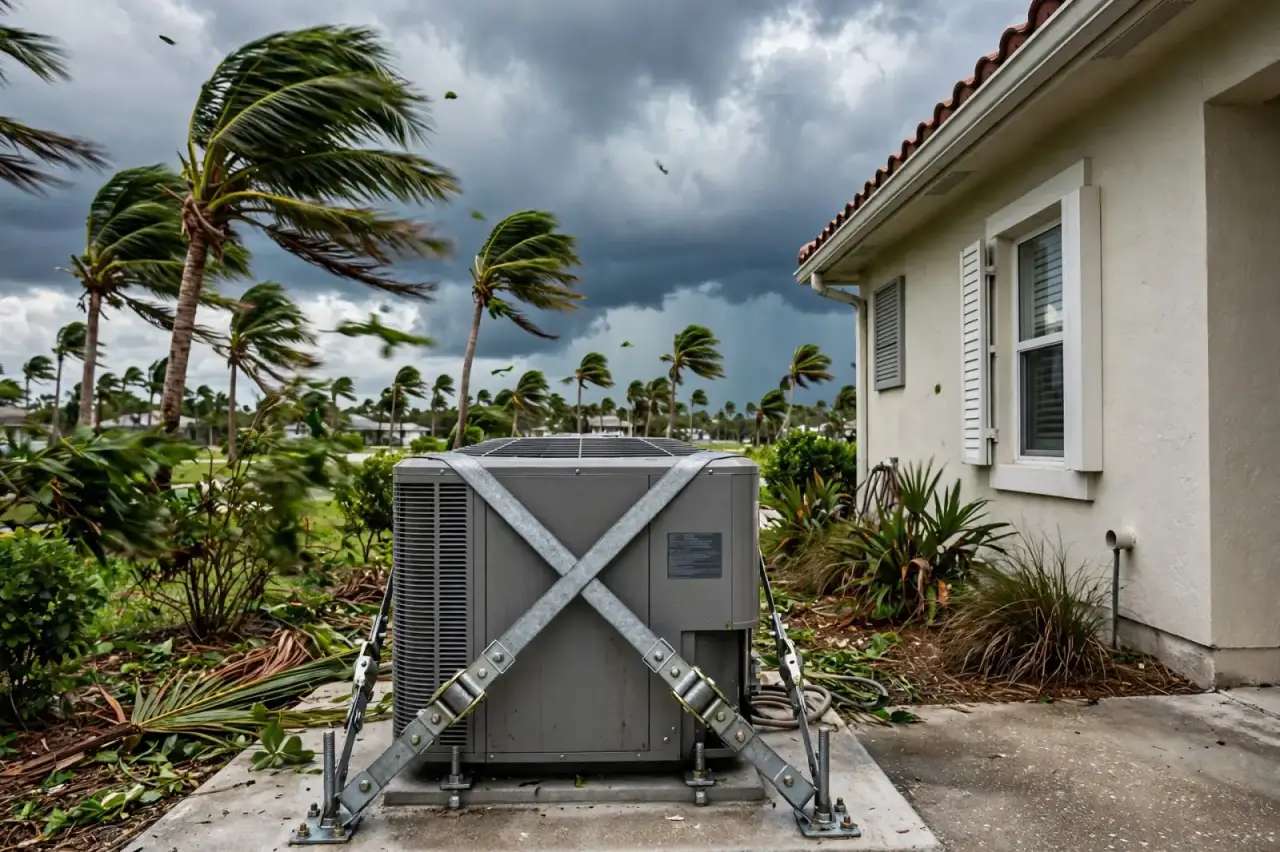
    AC unit secured with hurricane straps before storm
    Quick answer

    Turn your AC off at the thermostat and switch the breaker off before a hurricane reaches your area, clear debris and projectiles away from the outdoor unit, and do not run the system if it was flooded. After power returns, wait about 30 minutes before restarting, and call a technician if you see water damage, debris in the unit, or the AC will not cool.

    Before the Storm: Shut-Down Steps

    1. Pre-cool the house. About 48 hours before landfall, set the thermostat to 74 to 76 degrees and let the AC run. This pulls humidity out so the home stays comfortable longer after power is lost. Close all blinds and curtains.
    2. Turn the AC off at the thermostat AND the breaker. The thermostat alone does not disconnect the system from the grid. Shutting the breaker protects against surge damage when power returns unevenly across the neighborhood.
    3. Clear the area. Move patio furniture, potted plants, and garden tools away from the outdoor unit so wind cannot turn them into projectiles.
    4. Photograph the system. Document the model number, serial number, and current condition for insurance.

    Local tip: Broward homeowners who skip the breaker step are the ones who call us after the storm with fried control boards. It takes ten seconds and saves a service call.

    Should You Cover the Outdoor Unit?

    Skip the plastic tarp. Tarps trap moisture against the unit, accelerate rust, and if the system accidentally kicks on while covered, the compressor can overheat almost instantly. A breathable waterproof cover or plywood secured with straps can block flying debris, but remove it promptly after the storm. Plastic covers do more harm than good.
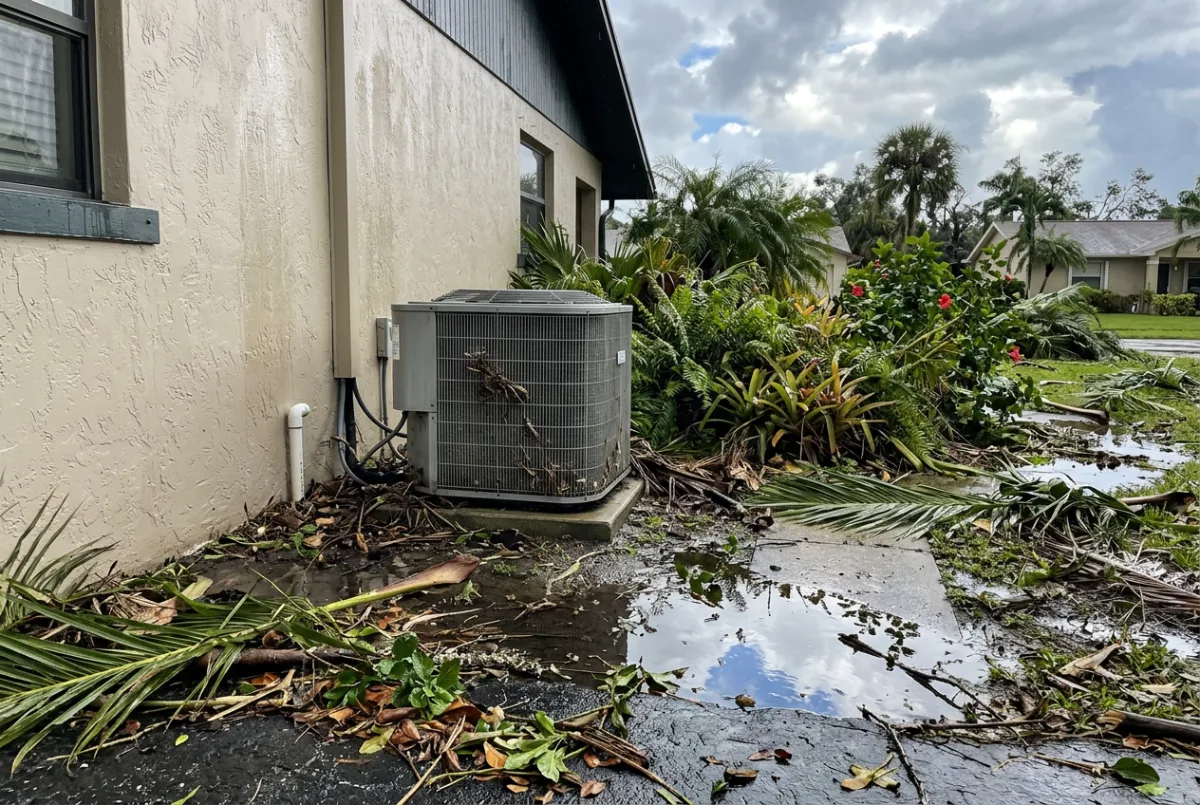
    Outdoor AC condenser surrounded by fallen palm fronds and debris after a storm
    After a storm, clear debris and check for water and damage before you restart the system.

    After the Storm: Safe Restart

    1. Wait at least 30 minutes after power returns so the electrical system stabilizes.
    2. Remove any cover. Inspect for debris lodged in the unit, standing water, or visible damage.
    3. Thermostat to OFF, breaker back on, then set the thermostat to cool. Wait at least 3 minutes between off and restart so the compressor does not start against unbalanced pressure.
    4. If the breaker trips immediately on reset, stop. That signals a serious electrical problem.

    Storm damage is not always visible. If the system struggles to cool, makes loud noises, or shuts down unexpectedly, schedule an inspection.

    If the Unit Was Flooded

    Shut off power at the breaker immediately and do not touch the unit while standing in water. Do not turn it back on after the water recedes, even if it looks fine. Hidden damage can cause failure weeks later. Per the industry standard (AHRI), flood-damaged heating and cooling equipment should generally be replaced, not repaired, with all work done by qualified contractors. If your system took on water, talk to us about replacement options before spending money on repairs.

    Surge Protection and Generators

    Modern AC equipment is full of sensitive electronics, which is why a layered approach is recommended: a whole-home surge protector at the panel plus dedicated protection at the outdoor unit. Professional installation typically runs $300 to $600. It will not stop a direct lightning strike (nothing at the panel can), but it handles the far more common nearby-strike and grid surges that fry control boards every storm season. Ask us about surge protection options when you book a visit.

    Good to know

    Frequently Asked Questions

    Should I cover my outdoor AC unit for a hurricane?

    Plastic tarps are discouraged: they trap moisture and can cause the compressor to overheat if the system starts while covered. A breathable cover or secured plywood for debris protection is acceptable if removed promptly after the storm.

    Why won’t my AC turn on after a power outage?

    Check the breaker first; it may have tripped during the outage or restoration. Wait 30 minutes after power returns before restarting. If the breaker trips immediately on reset, call a technician.

    Does a surge protector help my AC?

    Yes for the common surges from nearby lightning and grid restoration. It will not stop a direct strike. Layered protection (panel plus outdoor unit) is the recommended approach.

    Is storm damage to my AC covered by insurance?

    Hurricane, wind, lightning, and falling-tree damage are typically covered perils, minus your deductible. Flood damage is excluded from standard homeowners policies and needs separate flood insurance. Normal wear and tear is never covered.

    Need Help With Your AC?

    Cooling On Demand is available 24/7 across Broward and Dade County. Licensed, insured, and ready to help.

    Book Service OnlineCall (954) 203-8426

    Cooling On Demand Inc. is a Florida Certified Air Conditioning Contractor, license #CAC1822848. Services: Storm-season AC repair. Read our customer reviews.
  • The AC Refrigerant Change: What Broward Homeowners Need to Know

    The AC Refrigerant Change: What Broward Homeowners Need to Know

    Home / Blog / Buying Guide
    Buying Guide

    The AC Refrigerant Change: What Broward Homeowners Need to Know

    New ACs use R-454B instead of R-410A. Your existing system is still legal. Here is what the refrigerant change means for repairs and replacement.

    By Cooling On Demand Inc.FL License #CAC18228483 min read
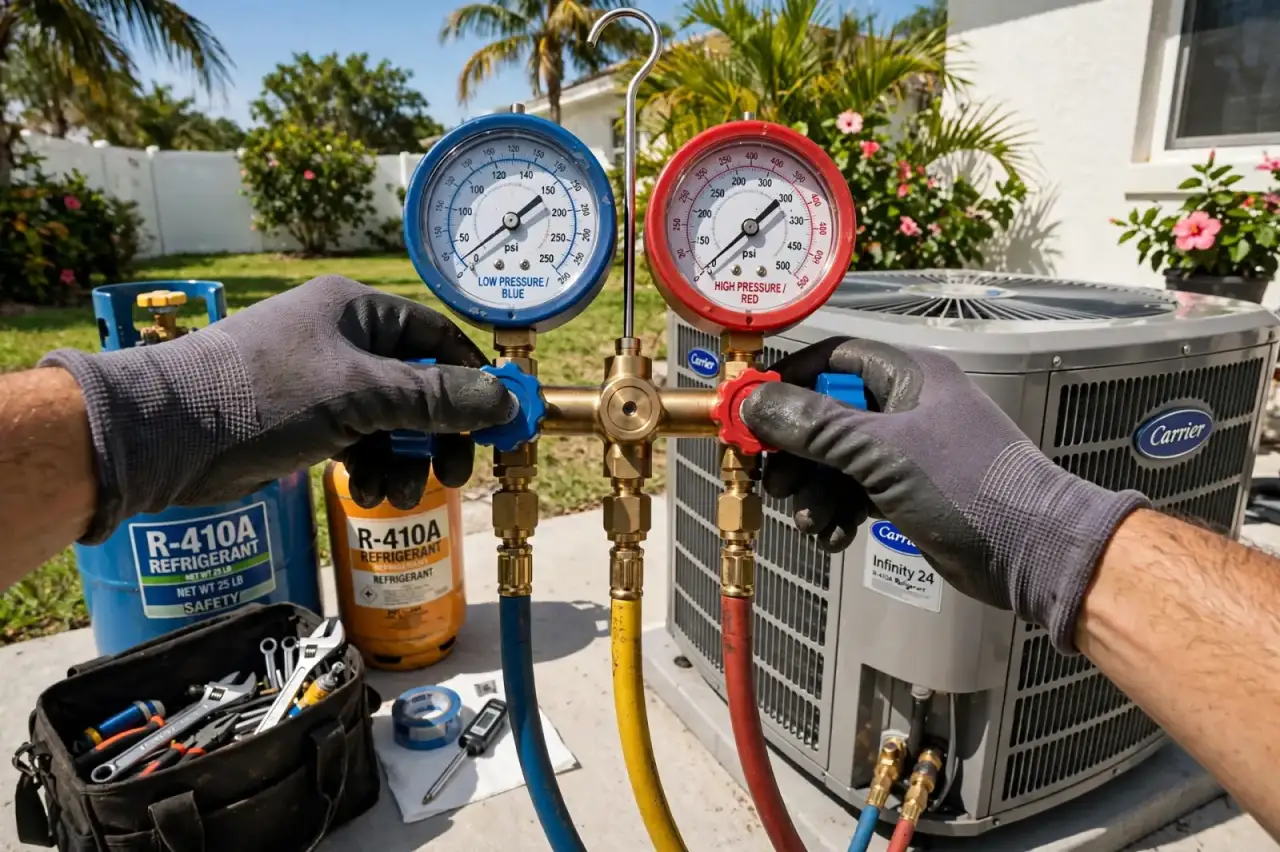
    HVAC gauges connected to AC unit for refrigerant service
    Quick answer

    No. Under federal rules, new home AC systems made from January 2025 use lower-impact refrigerants such as R-454B or R-32 instead of R-410A, but existing R-410A systems remain legal to run and repair. The change mainly matters if you are replacing your system soon or facing a costly refrigerant leak on an older unit.

    What Changed and When

    The EPA’s Technology Transitions Rule, issued under the American Innovation and Manufacturing (AIM) Act, requires an 85 percent cut in high-impact HFC refrigerants by 2036. As of January 1, 2025, new residential air conditioners and heat pumps can no longer be manufactured using refrigerants with a global warming potential above 700. R-410A, with a GWP of 2,088, no longer qualifies for new equipment.

    The two replacements you will hear about: R-454B (GWP about 465), used by Trane, Carrier, Lennox, Rheem, and Johnson Controls, and R-32 (GWP 675), used by Daikin. Both are mildly flammable (ASHRAE class A2L), so new equipment includes factory leak-detection sensors and mitigation controls. Lennox explains the R-454B transition here.

    Yes, completely. The rules apply only to newly manufactured equipment. There is no recall, no forced replacement, and no ban on servicing existing R-410A systems. Your current system can be repaired and recharged for years to come.

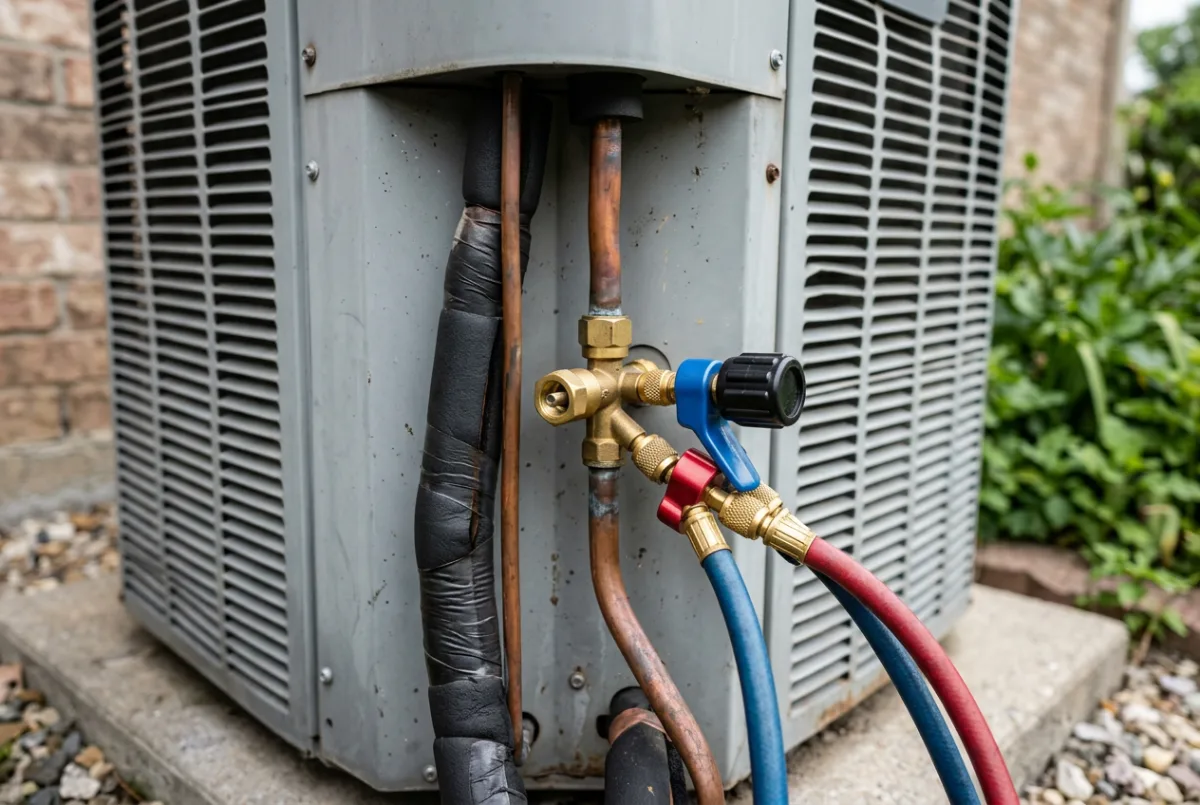
    Refrigerant charging hoses connected to the service valves of an outdoor AC unit
    Refrigerant work requires EPA certification, and recharging older R-410A systems is getting more expensive.

    Why Recharging Is Getting More Expensive

    R-410A production is restricted under the phasedown, so supply is tightening and prices are rising, especially for leak repairs that require adding significant refrigerant. A small top-off is one thing; a system that needs pounds of refrigerant every season is a sign the money is better spent on replacement. This is where the refrigerant change enters the repair-or-replace math.

    Can My R-410A System Be Converted to R-454B?

    No. The refrigerants require different compressor tolerances, expansion valves, operating pressures, and lubricants, and A2L equipment needs leak-detection hardware that R-410A systems lack. Attempting a conversion would damage the compressor, void the warranty, and create a safety hazard. When an R-410A system reaches end of life, it must be replaced with equipment designed for the new refrigerant. The good news: your existing ductwork and electrical usually do not need changes.

    What If My System Is 15+ Years Old?

    Systems that old may still use R-22, which was phased out of production years ago and is now extremely expensive. If you have an R-22 system, replacement is almost always the right call. Our post on how often to service your AC covers keeping older systems alive as long as they make sense.

    Questions to Ask Before You Buy

    • Which refrigerant does this equipment use, and what does the nameplate say?
    • Does the installer have current A2L handling training?
    • Who pulls the Broward County mechanical permit?
    • What are the warranty terms on the compressor and parts?

    If you are weighing a new installation, we install current-refrigerant equipment and will walk you through the options honestly. Call (954) 203-8426 for a straight answer about your specific system.

    Good to know

    Frequently Asked Questions

    What refrigerant does my AC use?

    Check the nameplate on the outdoor unit. Systems made roughly 2010 through 2024 use R-410A. Older systems may use R-22. New systems use R-454B or R-32.

    Is R-454B safe in my home?

    Yes when installed in equipment designed for it. It is mildly flammable (class A2L), but new systems include leak-detection sensors and safety controls specifically built for it.

    Can my R-410A system be converted to R-454B?

    No. Only the refrigerant listed on the unit’s nameplate may be used. Conversion would damage the system and void the warranty.

    Will R-410A refrigerant get more expensive?

    Likely yes. Production is restricted under the federal phasedown, so prices are expected to keep rising as supply tightens. This makes leak-prone older systems increasingly expensive to keep running.

    Need Help With Your AC?

    Cooling On Demand is available 24/7 across Broward and Dade County. Licensed, insured, and ready to help.

    Book Service OnlineCall (954) 203-8426

    Cooling On Demand Inc. is a Florida Certified Air Conditioning Contractor, license #CAC1822848. Services: AC repair. Read our customer reviews.
  • Why Does My AC Drain Line Keep Clogging in South Florida?

    Why Does My AC Drain Line Keep Clogging in South Florida?

    Home / Blog / AC Troubleshooting
    AC Troubleshooting

    Why Does My AC Drain Line Keep Clogging in South Florida?

    South Florida humidity feeds algae in your AC drain line. Learn why clogs happen, safe DIY fixes, and how tune-ups prevent them.

    By Cooling On Demand Inc.FL License #CAC18228483 min read
    Technician clearing AC condensate drain line
    Quick answer

    In South Florida, AC drain lines clog because constant humidity and year-round runtime feed algae and biological growth inside the line. When it backs up, a float switch shuts the system off or water leaks near the indoor unit. Regular drain cleaning during a tune-up, and a UV light at the coil, prevent most clogs.

    What the Drain Line Does

    Your AC pulls gallons of water out of humid Florida air every day. All of it exits through a narrow PVC drain line, usually to the outside of your home or a plumbing drain. It is a simple system with one weakness: warm, dark, constantly wet pipe is the perfect incubator for algae, mold, and slime.

    Technician observation: in Broward County, we clear more drain clogs than any other single repair. The pattern peaks in late summer when systems have been running hard for months and the lines are at their dirtiest. Homes with long drain runs or low spots where water sits are repeat offenders.

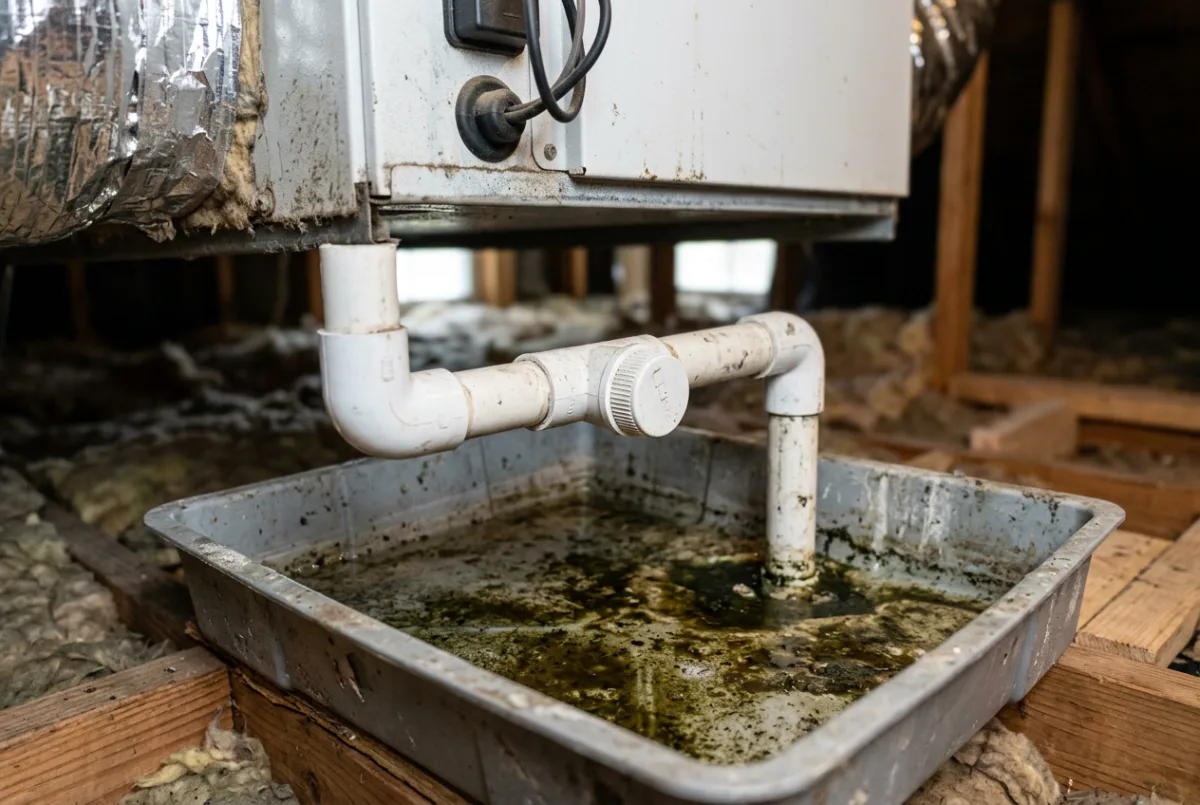
    AC secondary drain pan full of water and algae under a PVC condensate drain line
    Standing water and algae in a drain pan mean the condensate line is not draining.

    Signs of a Clog

    • Water stains on the ceiling or wall near the indoor unit
    • Musty smell when the AC runs
    • AC shuts off unexpectedly (the float switch doing its job)
    • Standing water in the drain pan
    • Gurgling sounds from the line

    Safe DIY: What You Can Do

    For routine prevention, pour a cup of distilled white vinegar into the drain line access port (usually a T-shaped vent near the indoor unit), let it sit 30 to 60 minutes, then flush with water. Do this monthly during cooling season. Vinegar is mildly acidic, kills algae, and is safe for PVC and copper.

    What about bleach? It is a stronger biocide, but it can corrode metal drain pans and coil fins if it backs up, and the fumes are unpleasant. Some contractors advise against bleach entirely. Our take: vinegar for monthly prevention, and call us for anything beyond that. Never mix vinegar and bleach.

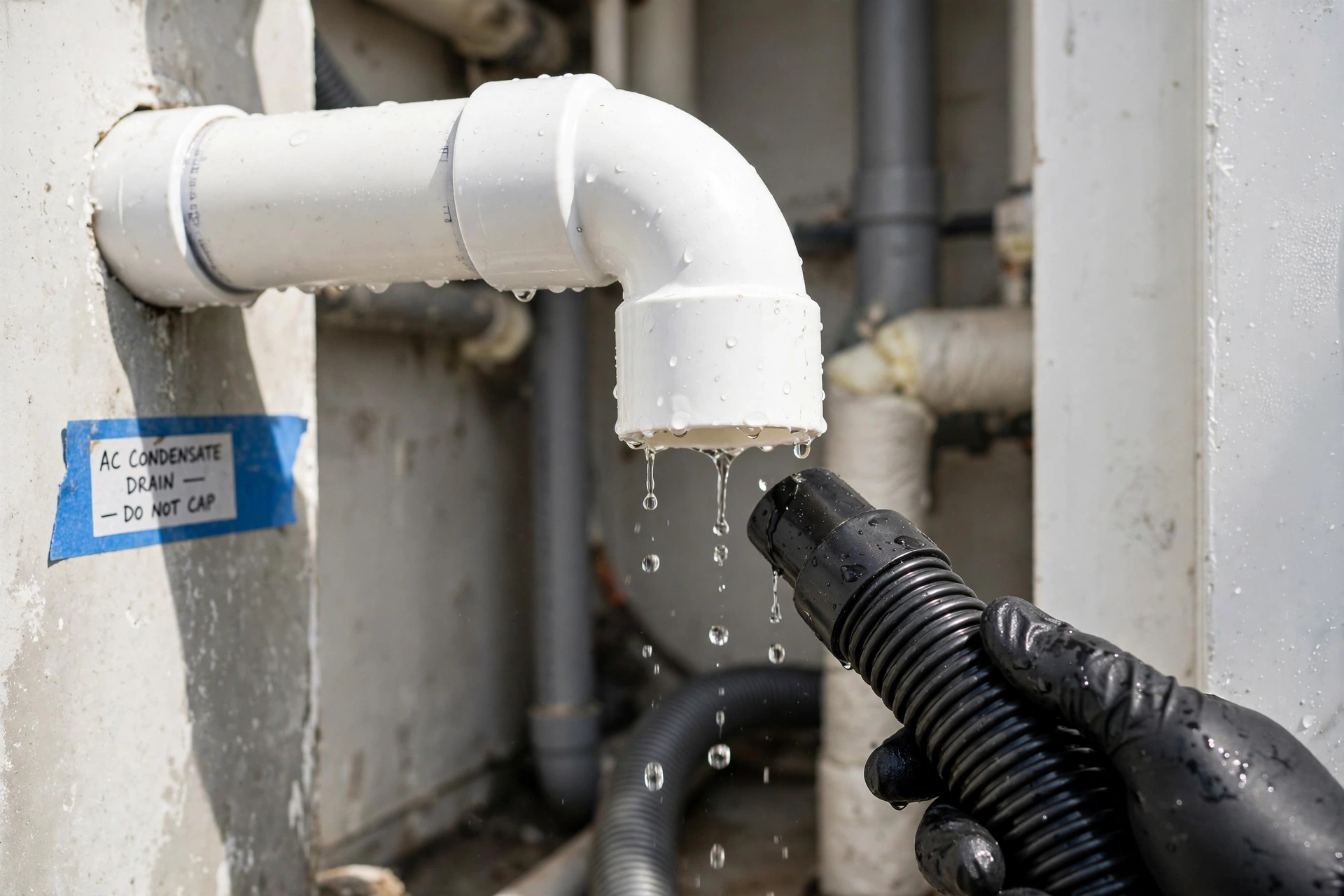
    For an active clog, a wet/dry vacuum on the outdoor end of the line can pull the blockage out. If water is already leaking into the ceiling, skip the DIY and call us.

    When to Call a Pro

    • Clogs keep coming back (the line may need rerouting or a deeper clean)
    • Water has reached drywall or flooring
    • The condensate pump is running constantly or not at all
    • You see mold growth around the air handler

    How Tune-Ups and UV Lights Prevent Clogs

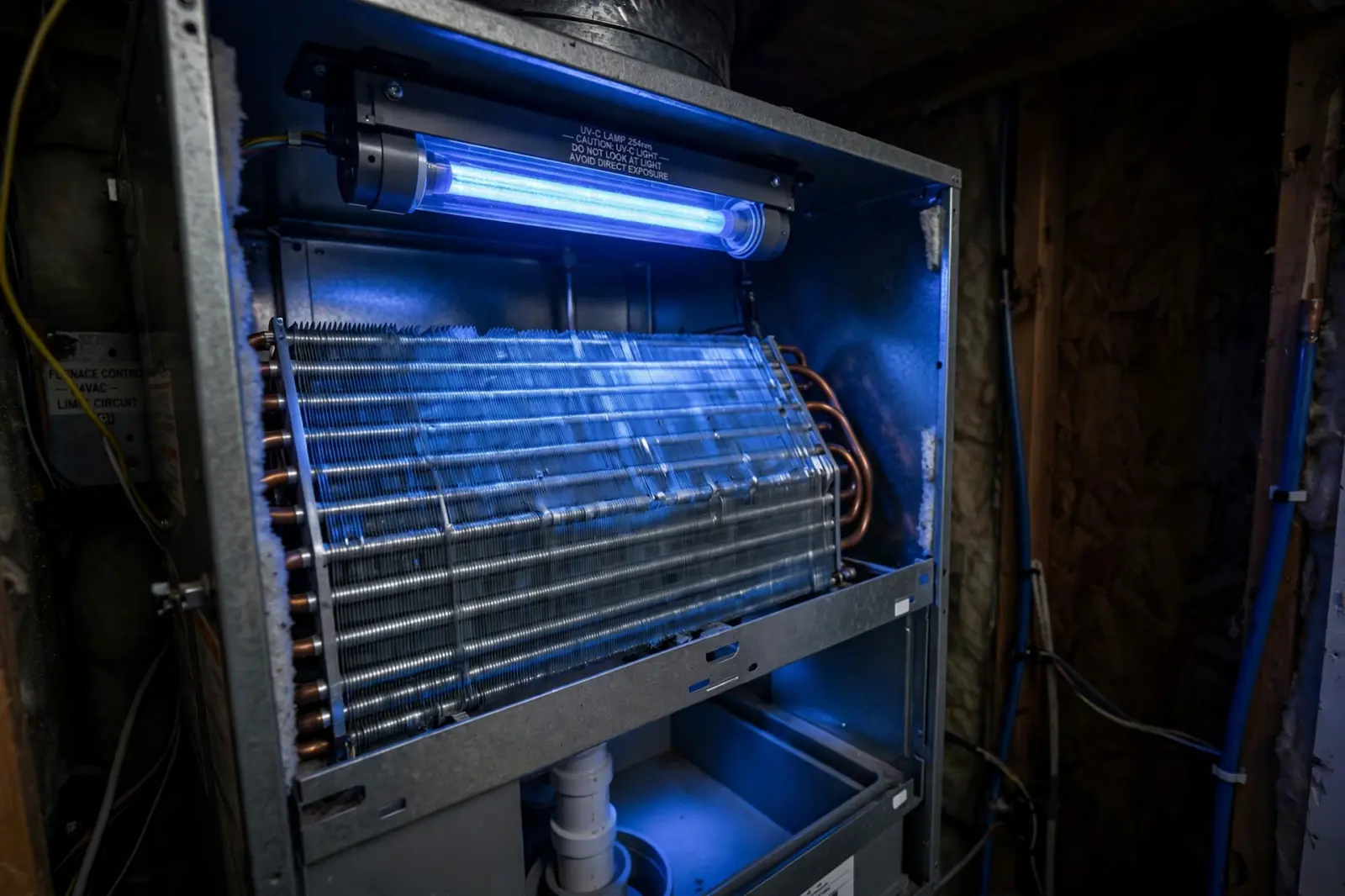
    Every tune-up we perform includes drain line and pan cleaning, which is why maintained systems rarely clog. For chronic problems, a UV-C light mounted at the evaporator coil keeps the coil and drain pan free of the biological growth that starts most clogs. It does not replace flushing, but it dramatically slows regrowth between services. Learn how UV lights work.

    Good to know

    Frequently Asked Questions

    How often should I flush my AC drain line?

    Monthly with vinegar during peak cooling season, quarterly at minimum. A professional clearing once a year before summer covers what DIY misses.

    Can I use bleach in my AC drain line?

    We recommend vinegar for routine use. Bleach is stronger but risks corroding metal components and producing fumes. If you use it, dilute heavily, ventilate, and never mix it with vinegar.

    Why does my AC turn off when the drain is clogged?

    A float switch in the drain pan detects rising water and shuts off the compressor to prevent flooding. It is a safety feature, not a malfunction. Clear the clog and the system restarts normally.

    Will homeowners insurance cover AC water damage?

    Standard policies cover sudden and accidental water damage but typically exclude gradual damage from neglected maintenance. A slow drain leak that seeps for months is the classic denied claim. Documented professional maintenance strengthens any claim. The AC unit itself is never covered; that is maintenance.

    Need Help With Your AC?

    Cooling On Demand is available 24/7 across Broward and Dade County. Licensed, insured, and ready to help.

    Book Service OnlineCall (954) 203-8426

    Cooling On Demand Inc. is a Florida Certified Air Conditioning Contractor, license #CAC1822848. Services: Drain clearing and AC repair. Read our customer reviews.
  • AC Stopped Working at Night? What to Check Before You Call

    AC Stopped Working at Night? What to Check Before You Call

    Home / Blog / AC Troubleshooting
    AC Troubleshooting

    AC Stopped Working at Night? What to Check Before You Call

    Your AC died at night. Before calling for emergency service, check these five things. Most nighttime outages are solved at step one or two.

    By Cooling On Demand Inc.FL License #CAC18228483 min read
    AC unit at night during emergency service call
    Quick answer

    Before calling for emergency service, check four things: the thermostat setting and batteries, the AC breaker in your electrical panel, the air filter, and the drain line float switch near the indoor unit. If none of those fix it, or you see ice on the lines, turn the system off and call a licensed 24/7 technician.

    The 5-Minute Checklist

    Work through these in order. Most nighttime “dead AC” calls we get are solved at step one or two.

    1. Thermostat

    Confirm it is set to COOL with the setpoint below the current room temperature, and the fan on AUTO. Replace the batteries if it uses them. Cancel any schedule holds. Then wait a few minutes: compressors have a built-in protection delay, so nothing may happen immediately.

    2. Breaker (Reset Exactly Once)

    Find the HVAC breaker in your electrical panel. Push it fully to OFF, wait a minute, then back to ON. If it trips again, stop. A breaker that keeps tripping signals an electrical fault, and forcing it risks real damage. Do not keep resetting it.

    3. Air Filter

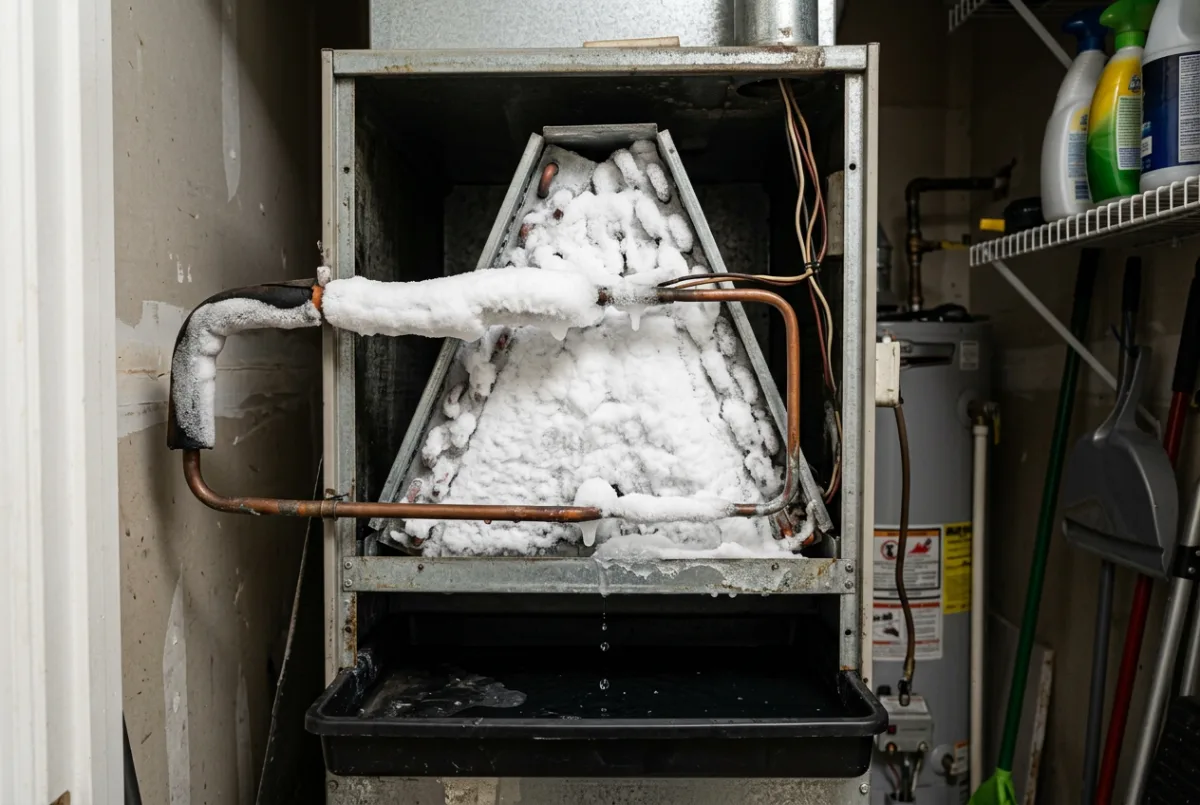
    Pull the filter and hold it to the light. If you cannot see through it, replace it. A fully blocked filter can freeze the evaporator coil solid, which shuts down cooling entirely.

    4. Float Switch and Drain Line

    Look for standing water in the indoor drain pan. A clogged drain line trips the safety float switch and shuts the system down to prevent flooding. This is the single most common cause of sudden AC shutdowns in South Florida. You can try a wet/dry vacuum on the outdoor end of the drain line.

    5. Switches and Disconnects

    Check the service switch near the indoor air handler (sometimes flipped off by accident) and the disconnect box by the outdoor unit. Both need to be ON.

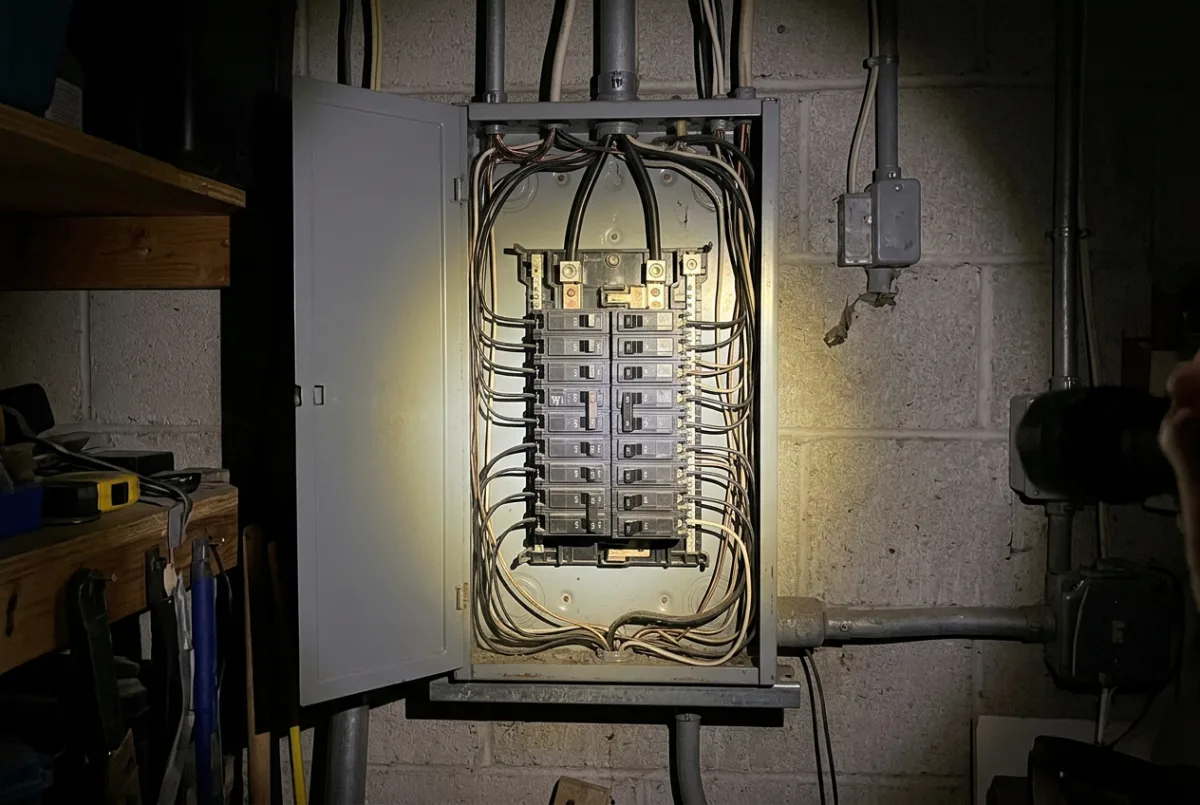
    Breaker panel lit by a flashlight with one double-pole breaker tripped
    A tripped breaker is one of the first things to check when the AC quits at night.

    Turn the AC Off Immediately If You See These

    • Ice on the refrigerant lines or coil: turn the system off but leave the fan running to thaw. Running a frozen unit can destroy the compressor.
    • Burning smell or grinding noises: shut it off at the breaker and call now.
    • Repeated breaker trips or visible water: leave it off until a technician looks at it.

    Keeping the House Cooler Until Help Arrives

    South Florida nights stay warm, so buy yourself comfort while you wait. Close all blinds and curtains. Set ceiling fans to spin counterclockwise to push air down. Put a bowl of ice water in front of a fan for a cheap cool breeze. Turn off the oven, dryer, and dishwasher. Sleep on the lowest floor, and keep exterior doors closed. If anyone in the home is elderly or very young and the house is getting dangerously hot, move to an air-conditioned public space.

    What a 24/7 Emergency Visit Looks Like

    When you book emergency service with us, a licensed technician arrives with a stocked truck, diagnoses the problem, and gives you an upfront price before any work starts. Most common nighttime failures (capacitors, contactors, drain clogs, thermostats) are fixed on the spot. We serve Sunrise, Plantation, Fort Lauderdale, and surrounding areas, day and night.

    When It Can Safely Wait Until Morning

    If the system runs but cools weakly, the house is tolerable with fans, and there are no alarming smells, ice, or water, it can usually wait for a daytime visit. You will save the after-hours surcharge, and the technician will have full parts access. When in doubt, call (954) 203-8426 and describe what you are seeing. We will tell you honestly whether it can wait.

    Good to know

    Frequently Asked Questions

    Why did my AC breaker trip?

    Common causes are a failing capacitor, a shorted wire, a dirty condenser forcing the compressor to overwork, or a weak breaker. One reset is fine. Repeated trips mean something is wrong and needs a technician.

    Is it safe to reset an AC breaker more than once?

    No. Reset once. If it trips again, leave it off. Forcing a tripping breaker can damage the compressor or create a fire risk.

    Why is my thermostat blank?

    Usually dead batteries or no power to the thermostat. Replace the batteries first. If it stays blank, check the breaker and the indoor service switch.

    How much does emergency AC repair cost?

    In South Florida, emergency repairs typically run $250 to $2,000 depending on the failed part, with after-hours surcharges of roughly $100 to $300 on top of standard rates. Common fixes like capacitors ($130 to $280) or drain cleaning ($75 to $200) are on the lower end. We always quote upfront before starting work.

    Need Help With Your AC?

    Cooling On Demand is available 24/7 across Broward and Dade County. Licensed, insured, and ready to help.

    Book Service OnlineCall (954) 203-8426

    Cooling On Demand Inc. is a Florida Certified Air Conditioning Contractor, license #CAC1822848. Services: Emergency AC repair. Read our customer reviews.
  • How to Check If an AC Contractor Is Licensed in Florida (Before You Let Them In)

    How to Check If an AC Contractor Is Licensed in Florida (Before You Let Them In)

    Home / Blog / Hiring Guide
    Hiring Guide

    How to Check If an AC Contractor Is Licensed in Florida (Before You Let Them In)

    Verify any Florida AC contractor in under a minute using the DBPR license lookup. Learn what CAC means, certified vs registered, and red flags.

    By Cooling On Demand Inc.FL License #CAC18228483 min read
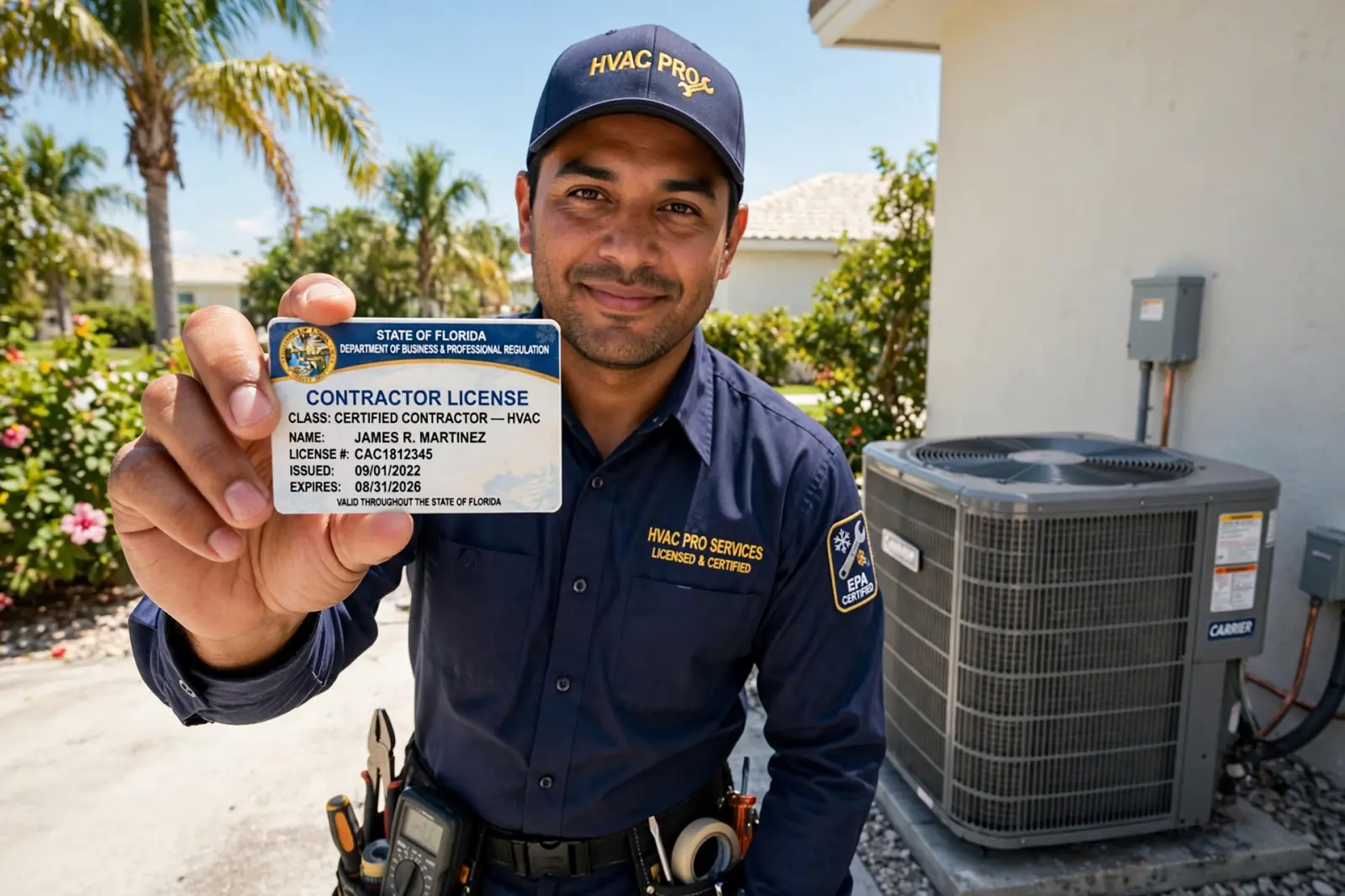
    Technician holding Florida contractor license card
    Quick answer

    In Florida, air conditioning contractors must be licensed by the Department of Business and Professional Regulation (DBPR). You can verify any contractor in under a minute at myfloridalicense.com by searching their license number. A valid result shows “Current, Active” and an expiration date.

    What License Does an AC Contractor Need in Florida?

    Florida requires a Certified Air Conditioning Contractor license (occupation code CAC) or a Registered Air Conditioning Contractor license for HVAC work. This is state law under Florida Statute Chapter 489. General handymen, even experienced ones, are not legally allowed to repair or replace central AC systems, handle refrigerant, or work on ductwork.

    Technician tip from our team: always ask for the license number before anyone touches your system. A legitimate contractor puts it on their truck, their estimate, and their website. Ours is CAC1822848, and we encourage you to look it up.

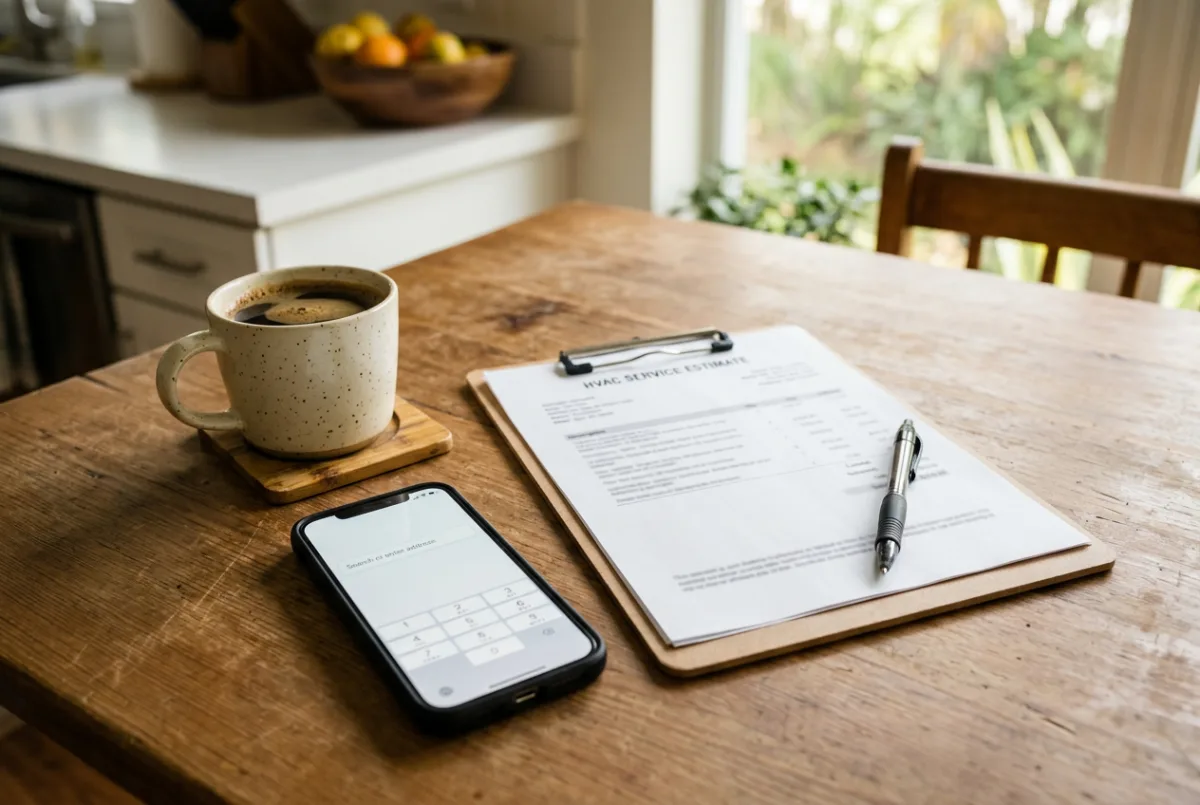
    HVAC estimate on a clipboard on a kitchen table with a phone and coffee
    Look up the license before you sign an estimate. It takes about two minutes.

    How to Look Up a License on the DBPR Site, Step by Step

    1. Go to myfloridalicense.com and click “Verify a License.”
    2. Search by license number (fastest) or by the licensee’s name.
    3. Open the license detail page and check three things: the license type, the status, and the expiration date.
    4. Confirm the status reads Current, Active. Anything else (Delinquent, Expired, Null and Void, Revoked) means the contractor is not authorized to work.
    5. Confirm the license type matches the work. For AC, you want Certified or Registered Air Conditioning Contractor.
    6. Check that the name on the license matches the business on your quote.

    The whole process takes about a minute. If a contractor hesitates to give you their number, that is your answer.

    Certified vs. Registered: What Is the Difference?

    Both are state-issued licenses, but they are not identical. A Certified contractor (license numbers starting with C) passed the state exam and met uniform state requirements, and may work anywhere in Florida. A Registered contractor (numbers starting with R) qualified through a local jurisdiction and may work only in the jurisdictions where registered. For a homeowner in Broward County, either is legal, but certified is the broader credential.

    Florida also classifies AC licenses by scope: Class A is unlimited, Class B is limited to 25 tons of cooling per system, and Class C covers servicing only. For a typical home, any of these can handle the work, but it is worth knowing what the letters mean.

    Red Flags That Mean Walk Away

    • Cash only, no written estimate. Legitimate contractors take traceable payments and put everything in writing.
    • No license number on the truck, website, or estimate. Florida requires it to be displayed.
    • No permit pulled for a full replacement. In Broward County, replacing an AC system requires a Mechanical Permit, and only a licensed contractor can pull it. No permit means no inspection, which becomes your problem at resale.
    • Pressure to decide today. A real diagnosis does not expire at midnight.

    Do You Need a Permit for a New AC in Broward County?

    Yes. Installing or replacing an air conditioning system in Broward County requires a Mechanical Permit, including equipment ratings documentation and hurricane tie-down details. The permit application must be submitted by a licensed contractor. This protects you: the inspection verifies the installation meets code before you pay the final invoice. If you are getting quotes for a new system, ask each bidder who pulls the permit. The right answer is always “we do.”

    Our License, Shown as an Example

    Cooling On Demand Inc. holds Florida Certified Air Conditioning Contractor license CAC1822848, currently active through 2028. Look it up yourself at myfloridalicense.com. We would rather you verify us than trust us, because that is how it should work for every contractor you invite into your home. More about our company and what our customers say.

    Good to know

    Frequently Asked Questions

    Is a handyman allowed to repair my AC in Florida?

    No. Florida law requires a licensed AC contractor for central air conditioning repair, refrigerant handling, and ductwork. A handyman may legally install a window unit or change a filter, but not service a central system. Unlicensed contracting is a first-degree misdemeanor on the first offense under Florida Statute 489.127.

    What does CAC stand for on a Florida license?

    Certified Air Conditioning Contractor. It is the DBPR occupation code for state-certified HVAC contractors.

    Does a new AC installation need a permit in Broward?

    Yes, a Mechanical Permit is required, and it must be pulled by a licensed contractor. The permit triggers an inspection that verifies the installation meets Florida building code.

    What happens if an unlicensed contractor damages my system?

    You lose the protections that come with a licensed contractor: the manufacturer’s warranty is typically voided, your homeowner’s insurance may deny related claims, and you have no DBPR complaint or restitution process. Always verify first.

    Need Help With Your AC?

    Cooling On Demand is available 24/7 across Broward and Dade County. Licensed, insured, and ready to help.

    Book Service OnlineCall (954) 203-8426

    Cooling On Demand Inc. is a Florida Certified Air Conditioning Contractor, license #CAC1822848. Read our customer reviews.
  • Repair or Replace? How to Decide

    Repair or Replace? How to Decide

    Home / Blog / Buying Guide
    Buying Guide

    AC Repair or Replace? How to Decide

    By Cooling On Demand Inc.FL License #CAC18228483 min read
    Repair or Replace? How to Decide
    In this guide

    The technician just told you the repair will cost $1,800, and your unit is 11 years old. Now what? Here is the honest math we walk our repair customers through every week.

    The 50 Percent Rule

    The industry rule of thumb: if the repair costs more than 50 percent of a new system, replacement usually wins. A $1,800 repair on a unit that would cost $6,000 to replace is 30 percent, which leans repair. A $3,500 repair is nearly 60 percent, which leans replace.

    But the percentage is only the start. Three other factors matter as much:

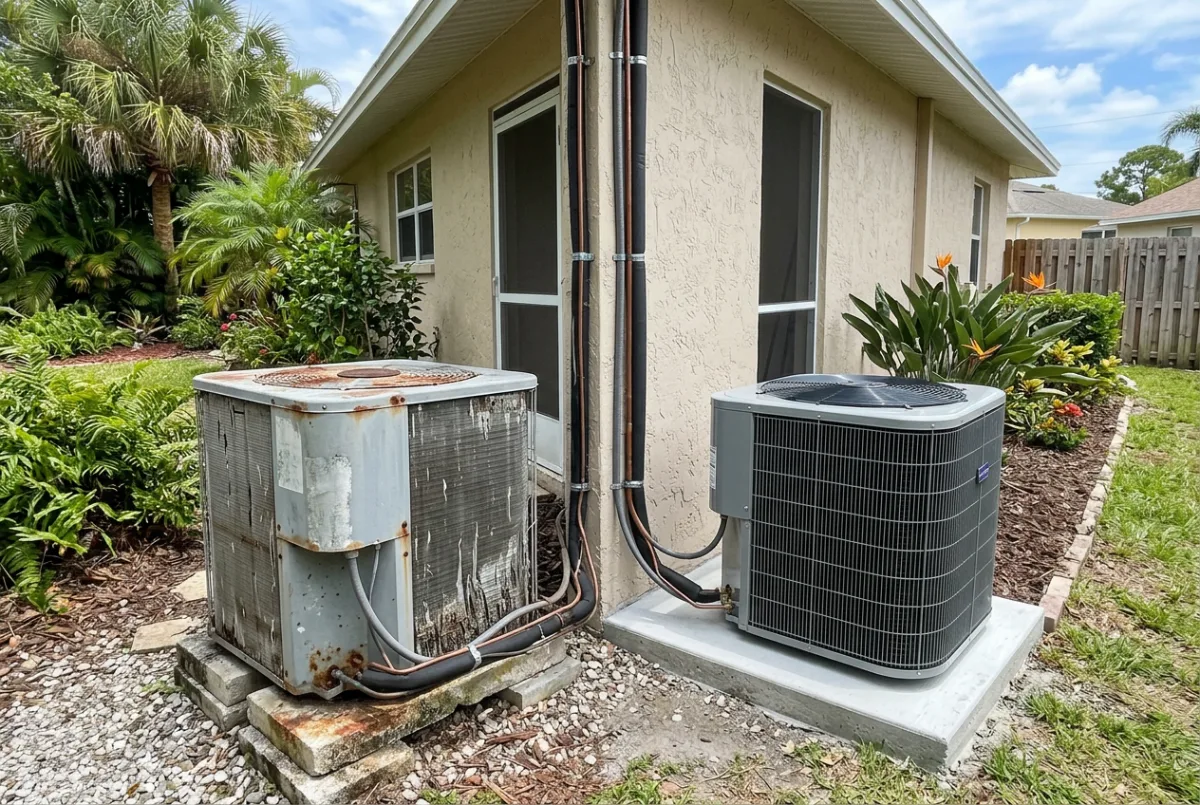
    Old rusted AC condenser next to a new condenser behind a Florida home
    Age, refrigerant type and repair cost decide whether repair or replacement makes sense.

    1. Age of the System

    In South Florida, a well-maintained AC lasts 12 to 15 years. Past year 12, every repair is a bet that nothing else major fails soon, and the odds get worse each year. Past year 15, replacement is almost always the smarter money.

    The Energy Star guide to heating and cooling suggests considering replacement for systems over 10 years old when facing significant repairs, especially since efficiency standards have improved.

    2. Refrigerant Type

    If your unit runs on R-22 (Freon), that refrigerant was phased out and is now expensive and hard to find. A leak repair on an R-22 system can cost more than the unit is worth. New systems use R-410A or the newer R-454B, which are readily available. If a tech mentions R-22, take replacement seriously.

    3. Your Energy Bills

    An old 10-SEER unit replaced with a modern 16-SEER2 system can cut cooling costs substantially. The Department of Energy’s central AC guide explains how SEER2 ratings translate to real savings. In Florida, where the AC runs most of the year, the payback math favors replacement sooner than in milder climates.

    Pull your last 12 months of FPL bills. If they have been climbing while your usage stayed flat, the unit is losing efficiency, and a new system starts paying for itself immediately.

    When Repair Is Clearly Right

    • The unit is under 8 years old
    • The repair is minor (capacitor, contactor, drain line, thermostat)
    • This is the first significant issue
    • Repair cost is well under the 50 percent threshold

    When Replacement Is Clearly Right

    • The unit is over 12 to 15 years old
    • It uses R-22 refrigerant
    • You have had 2 or more major repairs in the last 2 years
    • Repair cost exceeds half the replacement price
    • Your bills keep climbing despite regular maintenance

    What We Promise

    We do installations and repairs, so we have no incentive to push you either way. When we quote a big repair on an older unit, we will show you both numbers side by side and give you our honest recommendation. Then the call is yours.

    Get a free replacement quote or call (954) 203-8426 to talk through your situation.

    Need AC Help?

    Call any time, day or night, or book online in a minute.

    Book Service OnlineCall (954) 203-8426

    Cooling On Demand Inc. is a Florida Certified Air Conditioning Contractor, license #CAC1822848. Read our customer reviews.
  • How Often Should You Service Your AC in Florida?

    How Often Should You Service Your AC in Florida?

    Home / Blog / AC Maintenance
    AC Maintenance

    How Often Should You Service Your AC in Florida?

    By Cooling On Demand Inc.FL License #CAC18228483 min read
    How Often Should You Service Your AC in Florida?
    In this guide

    In most of the country, an AC tune-up once a year is plenty. Florida is not most of the country. Here is the honest schedule we recommend to our maintenance customers in Broward County.

    The Short Answer: Twice a Year

    South Florida air conditioners run nearly year-round. While a Minnesota unit might log 800 hours a season, a Sunrise unit can easily top 2,800. That workload means filters clog faster, coils collect growth faster, and drain lines back up faster.

    Our recommendation:

    • Spring (March to May): a full tune-up before the brutal summer season. This is the critical one.
    • Fall (October to November): a lighter check to clear the summer’s buildup and catch wear before the mild winter.

    The Energy Star program recommends annual professional maintenance at minimum, and Florida’s climate is exactly why twice is better here.

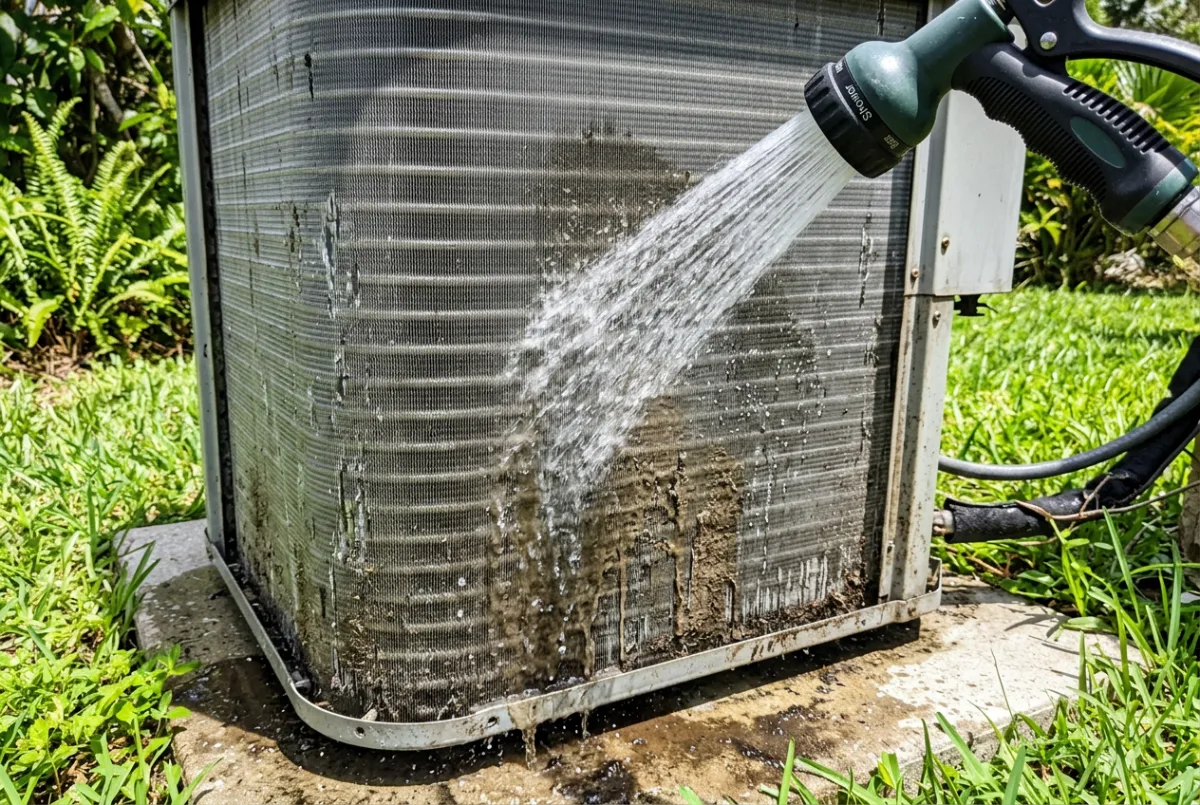
    Garden hose gently rinsing dirt off an outdoor AC condenser coil
    A clean condenser coil sheds heat faster, so the system runs shorter and cheaper.

    What a Proper Tune-Up Includes

    Not all tune-ups are equal. Ours covers:

    • Drain line and pan cleaning (the number one cause of emergency calls in South Florida)
    • Evaporator and condenser coil cleaning and sanitizing
    • Refrigerant level check
    • Electrical connections and capacitor testing
    • Thermostat calibration
    • Air filter replacement
    • Full system performance measurement

    From $115, it takes about 60 to 90 minutes. Compare that to the cost of a failed compressor on the hottest Saturday of August.

    What Happens If You Skip It

    We see the pattern every summer. The units that break down in July are overwhelmingly the ones that skipped spring service. Clogged drain lines overflow into ceilings. Dirty coils freeze up. Capacitors that would have been caught in testing fail under load.

    There is also the warranty angle: most manufacturers require documented annual professional maintenance to keep the warranty valid. Skip service, and a future warranty claim can be denied. The Florida DBPR licenses contractors like us (our license is #CAC1822848) specifically so homeowners have recourse, but the warranty fine print is between you and the manufacturer.

    Signs You Are Overdue

    • It has been more than 12 months since your last service
    • Your energy bills are creeping up
    • The air smells musty when the system starts (you may also want to read about UV lights and air purification)
    • Water stains near the indoor unit (drain line warning)
    • The system runs longer than it used to

    Maintenance Plans

    Many of our customers put the schedule on autopilot with a continuing maintenance plan: we handle the timing, you get priority scheduling and documented service records. Book your tune-up or call (954) 203-8426 to ask about plan options.

    Need AC Help?

    Call any time, day or night, or book online in a minute.

    Book Service OnlineCall (954) 203-8426

    Cooling On Demand Inc. is a Florida Certified Air Conditioning Contractor, license #CAC1822848. Read our customer reviews.
  • 5 Signs Your AC Needs Repair Before Summer Hits

    5 Signs Your AC Needs Repair Before Summer Hits

    Home / Blog / AC Troubleshooting
    AC Troubleshooting

    5 Signs Your AC Needs Repair Before Summer Hits

    By Cooling On Demand Inc.FL License #CAC18228483 min read
    5 Signs Your AC Needs Repair Before Summer Hits
    In this guide

    Florida heat does not give warnings. Your AC usually does, if you know what to listen for. Here are the five signs we see most often on repair calls across Broward County, and what each one means.

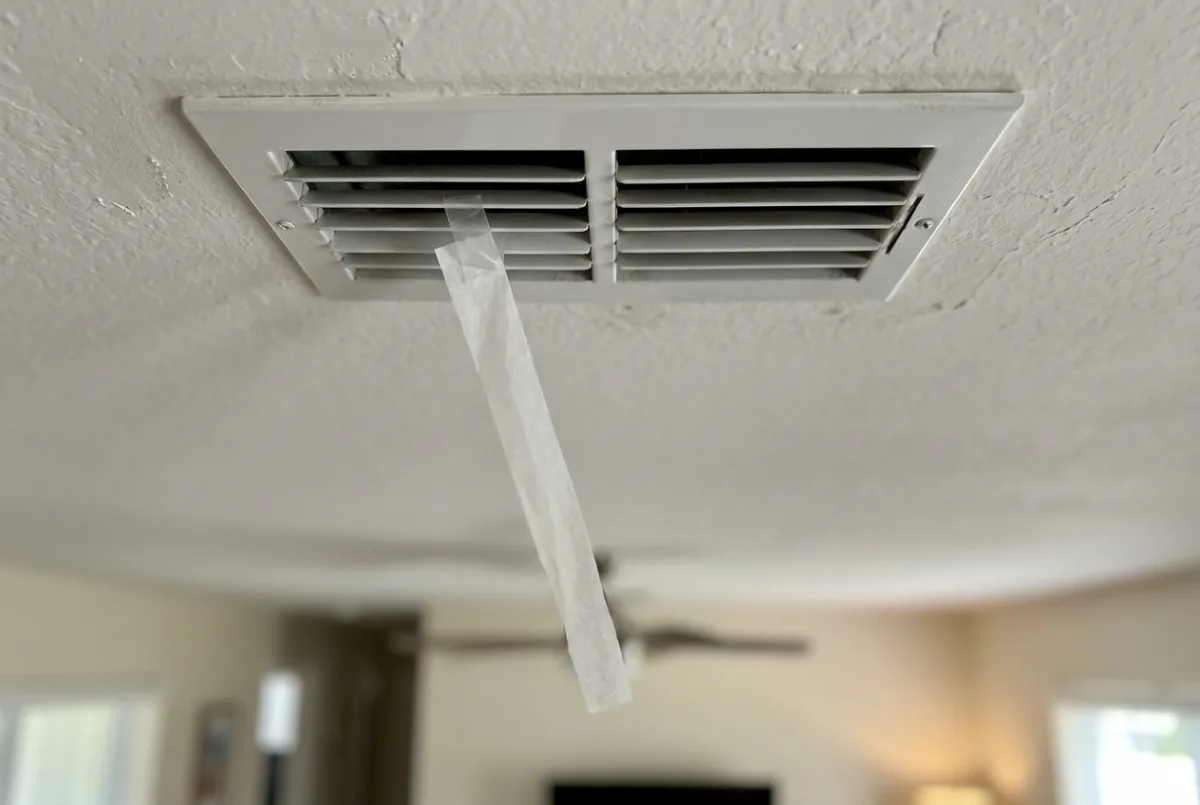
    Tissue strip hanging almost straight down from a ceiling vent showing weak airflow
    The tissue test: if a strip of tissue barely moves at the vent, airflow is weak.

    1. Weak Airflow From Your Vents

    When the air coming out of your vents feels more like a suggestion than a breeze, something is restricting the system. The usual suspects are a clogged air filter, a failing blower motor, or ductwork that has come loose. In South Florida homes, we also see evaporator coils caked with dust and biological growth, which choke off airflow fast.

    Start with the easy check: pull your filter. If you cannot see light through it, replace it. If airflow is still weak with a clean filter, book a check-up before the strain burns out the blower motor, which is a far more expensive fix.

    2. Strange Noises

    Air conditioners hum. They do not bang, screech, rattle, or hiss. Each sound points somewhere specific:

    • Banging or clanking: something loose or broken inside, often a blower assembly or compressor part.
    • Screeching: usually a worn blower motor bearing or belt.
    • Hissing: can mean a refrigerant leak, which needs a licensed tech right away.
    • Clicking at startup or shutdown: normal in small doses, but constant clicking can signal a failing thermostat or electrical control.

    The Energy Star maintenance guide notes that catching these early is the difference between a minor repair and a system replacement. If your unit started making a new noise this week, do not wait for it to get louder.

    3. Warm Spots in Some Rooms

    When the living room is an icebox and the back bedroom feels like a sauna, the system is not distributing air evenly. Causes range from blocked or leaking ducts to an aging system that can no longer keep up with the Florida heat load. Homes with additions or converted garages are especially prone to this.

    A seasonal tune-up often resolves it: cleaning the coils, checking refrigerant charge, and verifying airflow room by room. If the system is over 12 years old and struggling, read our guide on whether to repair or replace.

    4. Your Energy Bill Keeps Climbing

    A sudden spike in your FPL bill with no change in your habits almost always traces back to the AC, which is the biggest electricity user in most Florida homes. As efficiency drops, from dirty coils, low refrigerant, or an aging compressor, the system runs longer to do the same job.

    According to the U.S. Department of Energy, regular maintenance can restore much of that lost efficiency. Our $89.99 check-up measures exactly where your system is losing ground.

    5. Frequent Cycling or Running Nonstop

    An AC that turns on and off every few minutes (short cycling) or one that runs all day without ever reaching the set temperature is telling you something is wrong. Short cycling often means an oversized unit, a refrigerant issue, or a thermostat problem. Running nonstop usually means the system cannot meet the cooling load anymore.

    Both patterns wear out components fast and spike your bill. If you notice either, call (954) 203-8426. We answer 24/7.

    What To Do Next

    One or two of these signs? Start with a filter change and a thermostat check. Three or more, or any single sign that appeared suddenly, means it is time for a professional look. Our AC repair service covers all of Broward County with upfront pricing and a free diagnostic with any repair.

    Need AC Help?

    Call any time, day or night, or book online in a minute.

    Book Service OnlineCall (954) 203-8426

    Cooling On Demand Inc. is a Florida Certified Air Conditioning Contractor, license #CAC1822848. Read our customer reviews.
Call (954) 203-8426